

Key Takeaways:
- Lightning Labs CTO Olaoluwa Osuntokun built a prototype to secure bitcoin wallets from quantum risk.
- Tests show <1 min proof time and 1.7MB size, offering scalable recovery for Bitcoin users.
- BIP-360 gains urgency as quantum threat debate grows, with adoption possible in next few years.
New Tool Aims to Save Bitcoin Wallets From Quantum Threat
A senior bitcoin developer has introduced a prototype designed to solve a long-standing problem: how to protect users if the network ever faces a quantum computing threat.
Olaoluwa Osuntokun, Chief Technology Officer at Lightning Labs, has built a working system that could allow users to recover funds from vulnerable wallets. The tool comes as developers continue to debate how bitcoin should respond to future advances in quantum computing.
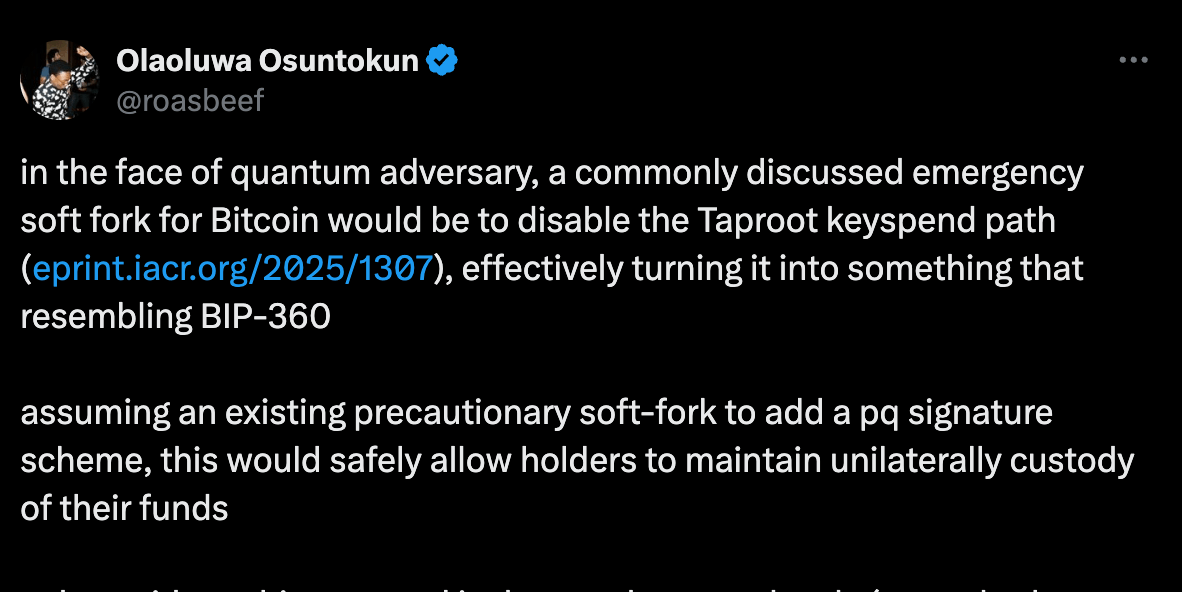
Bitcoin’s security relies on cryptographic signatures. In theory, powerful quantum machines could break these signatures and expose private keys. To prepare, developers have proposed upgrades such as BIP-360, which introduces quantum-resistant wallet structures.
However, migrating funds to new wallets would take time, as not all users would act quickly. That creates a risk if the network adopts an emergency measure, often called an “emergency brake,” which would disable existing signature methods to prevent attacks. Such a move could secure the network but also leave many users locked out of their own wallets.
Osuntokun’s prototype addresses this gap. Instead of relying on signatures, the system allows users to prove ownership using their wallet’s original seed phrase. It does so without revealing the seed itself, preserving security across related wallets.
The approach uses zero-knowledge proofs. In simple terms, users can demonstrate that a wallet was derived from their secret key without exposing it. This creates an alternative path to move funds if traditional methods are no longer available.
The prototype is already functional. Tests show that generating a proof takes under a minute on consumer hardware, while verification takes seconds. The proof file is about 1.7 megabytes in size.
Despite this progress, the tool has no formal proposal for inclusion in bitcoin’s codebase with no timeline for adoption. The broader question remains unresolved. Some researchers argue that practical quantum attacks are still distant. Others believe preparation must happen now to avoid systemic risk.
Market sentiment reflects this uncertainty. Prediction markets suggest a moderate chance that quantum-resistant upgrades like BIP-360 could be implemented within the next few years.
For now, Osuntokun’s work stands as a proof of concept. It demonstrates that a technical solution exists to balance security with user access. If quantum threats ever become real, such tools could play a critical role in ensuring that protecting the network does not come at the cost of freezing user funds.