
Cyberdecks are having a moment. But they’re not quite as original as many of their Gen Z makers might think.
These quirky, personalized DIY computer builds, often with impractically tiny keyboards, keep appearing in new forms on Instagram and TikTok. They include cyberdecks crammed inside Altoids tins, reading cyberdecks that look like books, and suitcase cyberdecks for music production.
Most telling are the so-called girly cyberdecks, mostly made by women with deliberately over-the-top bling, such as the gold clamshell model with gold ring-covered mouse from TikTok user Ube Boobey. The London-based 22-year-old has garnered more than 5 million views since posting her first cyberdeck, back in March.
“I have no previous experience with tech,” noted Boobey, real name Annike Tan, on her first post. “That’s not a cyberdeck, it’s a load of components stuffed in a clutch bag,” griped one commenter. “Yeah U right,” Tan responded, deadpan.
And yet, the load of components worked — so much so that Tan got what most startup founders would kill for, a Wired magazine feature, a mere month later. This was no mere retro trend; these charmingly amateur computer builds caught a mood, an exhaustion with the tech establishment, a need to revolt against the prevailing winds of Silicon Valley.
Just like they did 50 years ago, in fact.
Everything old is new again: The origins of the cyberdeck
The name cyberdeck traces back to sci-fi author William Gibson’s groundbreaking 1984 novel Neuromancer, where it was technically called a “cyberspace deck.” (Gibson had invented the term “cyberspace” in an earlier story from 1982, but popularized it here.) In the first chapter, our protagonist is “jacked into a custom cyberspace deck that projected his disembodied consciousness into the consensual hallucination that was the matrix.”
Mashable Light Speed
The only part of that description that really applies is “custom.” Another Gibson novel, Idoru (1996), comes closer to the modern cyberdecker ideal with its description of “sandbenders” — charmingly amateur computers made by a commune in Oregon, with materials like coral, turquoise, and an aluminum chassis made from melting old cans found on the beach.
For the historical origins of cyberdecks, however, you have to go further south than an Oregon beach. You have to go back to the old Silicon Valley, a place where companies like Hewlett-Packard made deathly dull early computers for corporate use.
The Homebrew Computer Club was founded in March 1975 by engineer Gordon French and activist Fred Moore, both of whom believed that “personal” computers, rather than boxy IBM-style mainframes, were the future. The people they attracted (using fliers, in the absence of social media) were hobbyists and hippies. One was John Draper, who’d made himself infamous by building a “blue box” that allowed anyone to make free long-distance phone calls, earning the ire of AT&T. Another two were kids who’d turned a quick profit selling Draper’s dubious blue boxes at UC Berkeley: Steve Wozniak and Steve Jobs.
Attendees were encouraged to bring their homemade computers. They cooed over digital tape drives that could hold an unheard-of 500 kilobytes of data. They applauded when machines built from a kit could be made to play music.
“I expect home computers will be used in unconventional ways,” Moore wrote in the first newsletter, “most of which no one has thought of yet.”
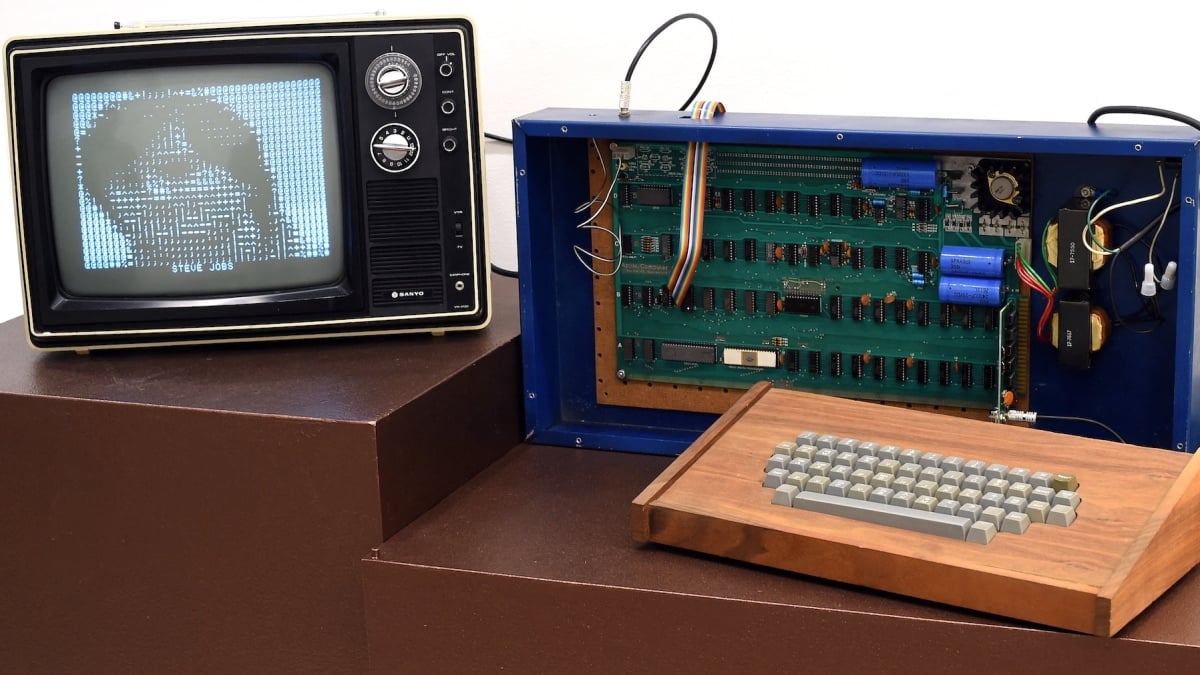
Wozniak took that promise and ran with it. In 1976 he showed off a machine he’d designed while working at Hewlett-Packard, one so homebrew that his superiors at HP had refused to make it. It didn’t even have a housing, so early users had to bring their own wooden boxes or suitcases. The parts were $500, but they made copies to sell to other members at cost. His friend Jobs was so enthusiastic, he wanted the pair to start a company and contributed the name of the device, based on a happy summer of fruit-picking in Oregon. It was called the Apple Computer A, later renamed the Apple I.
That, of course, was where modern personal computing began. You could argue Steve Jobs perverted the cyberdeck-style Wozniak machine when he made the pair of them millionaires, but you’d also have to note that he repeated the same lesson when he returned to Apple in 1997. PCs had become indistinguishable “beige boxes” in the 1990s, so Jobs brought us the candy-colored iMac — exactly what a cyberdecker might make with the help of unconventional designers like Jony Ive.
Now here we are, again, in a world where all computer-based devices are starting to look boringly similar. Apple doesn’t make beige boxes, but it does make aluminum boxes that, if you’re lucky, come in a choice of colors. Silicon Valley, with its emphasis on AI that consumers increasingly distrust, is starting to look as out of touch as it did in the 1970s. What better time for a homebrew-style rebellion?
The cyberdeck makers of the 21st century, are, of course, drawn from a much more diverse array of folks than the uniformly white and male members of the Homebrew Computer Club. Wozniak would never have thought of stuffing his components in a clutch bag and seeing what happened. But as with its 1970s predecessor, the cyberdeck movement will create computers that are used in unconventional ways. Most of which no one has thought of yet.