In Bitcoin news today, the United States and China are no longer just competing over semiconductors, trade routes, and military influence; they are now racing to dominate Bitcoin.
With President Trump announcing plans to establish a Bitcoin Strategic Reserve and US military commanders openly testifying that BTC can be used as a tool of power projection, the conversation has shifted from ‘should governments own Bitcoin’ to ‘which government owns the most.’
The US straight-up cannot lose the Bitcoin race to China.
While Beijing stacks massive BTC reserves and rolls out their surveillance digital yuan, America needs to go full send on the Strategic Bitcoin Reserve, mining dominance, and pro-innovation rules.
Military already… pic.twitter.com/yLv9TIEK3g
— Jessica Gonzales (@lil_disruptor) May 19, 2026
If Bitcoin is becoming a reserve asset at the nation-state level, like gold or oil before it, then the country that accumulates the most, controls the most mining infrastructure, and sets the rules for its use may hold a decisive advantage in the next era of global finance.
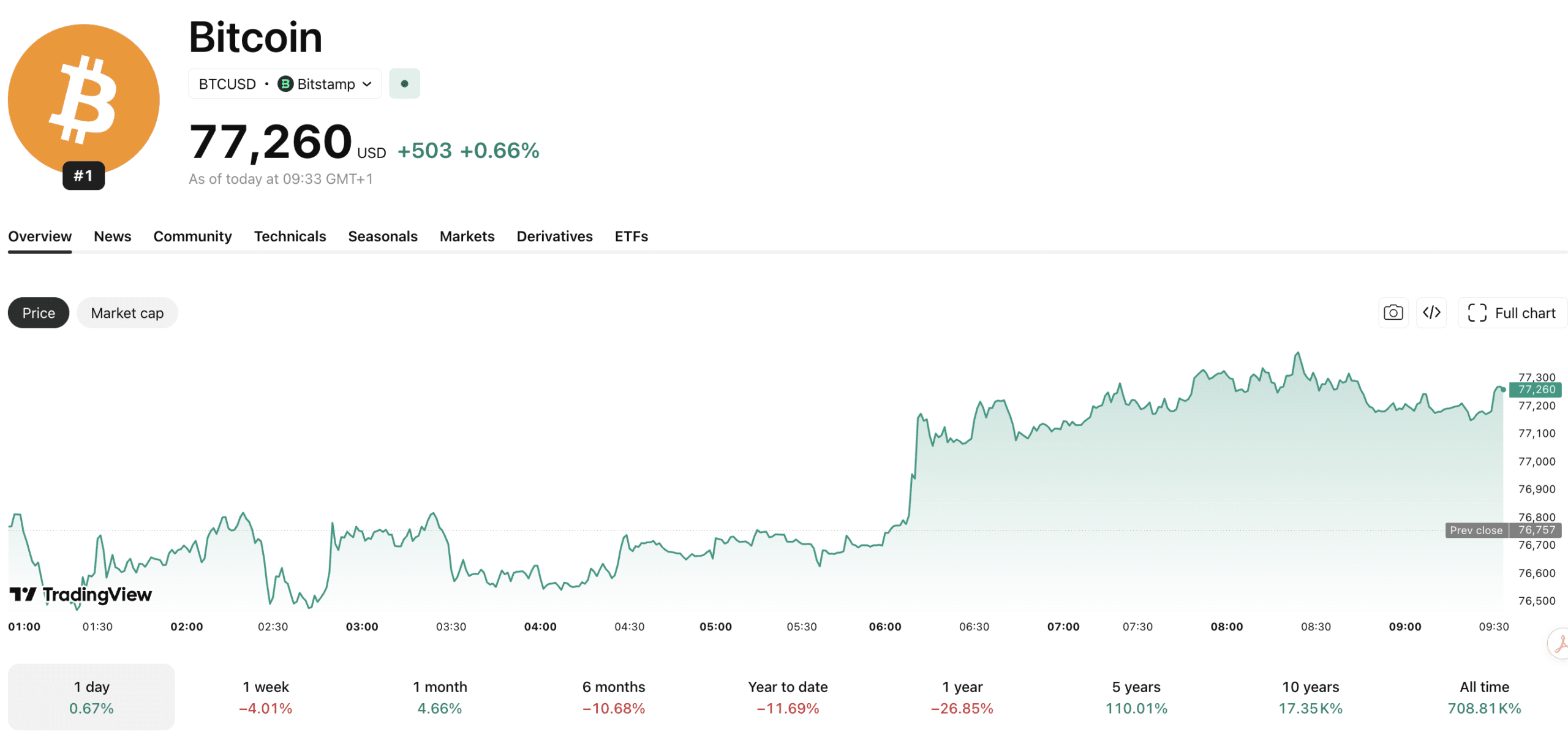
This ongoing race to dominate the BTC space comes as the leading digital asset struggles to reclaim $80,000. BTC USD is relatively flat on the day, up a modest +0.3% and trading for around $77,300.

Bitcoin News Today: Why Governments Now View BTC as a National Security Asset
The Digital Gold Race can be likened to the 1960s space race, where controlling new territories holds immense power. In this context, Bitcoin is the new territory, and dominance over it extends beyond finance.
The US dollar’s historical dominance has allowed the US to enforce sanctions and project global influence through financial control. However, digital assets now challenge that structure. As opinion columnist Gooden noted, the nation leading in digital assets could redefine how money flows and how global power is wielded.
The US government reportedly holds over 200,000 BTC, primarily from seizures and enforcement actions, making it one of the largest holders globally. The shift in perception, from viewing Bitcoin as contraband to a strategic asset, is significant.
Legislation is evolving to support US leadership in digital asset regulation. The draft Crypto Market Structure Bill, along with the CLARITY and GENIUS Acts, seeks to retain crypto firms and talent within the US, preventing them from moving to more lenient regulatory environments abroad.
The US Strategic Position: What Washington Is Actually Building
JUST IN:
Four-star military officer Admiral Samuel Paparo confirms the USA is running a Bitcoin node.
"We have a node on the Bitcoin network right now. We're doing a number of operational tests to secure and protect networks using the Bitcoin protocol." pic.twitter.com/4JIOIMtlTW
— Bitcoin Magazine (@BitcoinMagazine) April 22, 2026
The military’s stance on Bitcoin is becoming increasingly concrete. US Indo-Pacific Commander Admiral Samuel Paparo testified to Congress that Bitcoin can be used for power projection, mentioning that the military has deployed a live node for operational testing.
Secretary of War Pete Hegseth affirmed its utility against China’s digital authoritarianism, stating, “Yes and yes.” Pentagon official Major Jason Lowery noted that Bitcoin’s proof-of-work mechanism imposes a physical cost on network attacks, thereby enhancing cyber defenses.
On the institutional front, BlackRock’s regulated Bitcoin products show growing demand for BTC, indicating that major players view it as a long-term asset rather than a trade.
The US also leads in Bitcoin mining, especially after China’s 2021 ban, with domestic mining increasingly recognized as critical infrastructure vital to securing the network.
China’s Counter-Move: The Dual-Track Strategy Explained

In other Bitcoin news today, China’s strategy in the US-China crypto competition is more complex than a simple crackdown narrative suggests, involving two parallel approaches.
First, the digital yuan has moved beyond domestic trials, with applications in civil servant salaries, cross-border settlements, and trade with Africa and the Middle East. This aims to create a payment infrastructure that sidesteps the US-led financial system and reduces exposure to dollar sanctions.
Second, despite a ban on domestic crypto, China reportedly holds about 190,000 BTC, mainly seized from the 2019 PlusToken scam, making it the second-largest state holder of Bitcoin.
This duality is significant: China publicly bans crypto while stockpiling it as a state asset. The CCP is promoting a centralized digital currency for control while accumulating decentralized Bitcoin.
Additionally, China influences global Bitcoin mining through companies like Bitmain and MicroBT, which dominate the hardware supply chain. Control over this supply chain offers substantial leverage over the future of Bitcoin mining.
EXPLORE: Best Crypto Presales Gaining Traction Right Now
Follow 99Bitcoins on X, YouTube, and Telegram for more crypto news and analysis.
The post Bitcoin News Today: Why the US and China Are in a Crypto Space Race appeared first on 99Bitcoins.