
Key Takeaways
- SEC approved Nasdaq to list bitcoin index options on Phlx under ticker QBTC.
- Cash-settled QBTC contracts eliminate custody and assignment risks, broadening institutional bitcoin access.
- Trading cannot begin until the CFTC grants exemptive relief, as bitcoin is classified as a U.S. commodity.
What Cash-Settled Means And Why It Matters
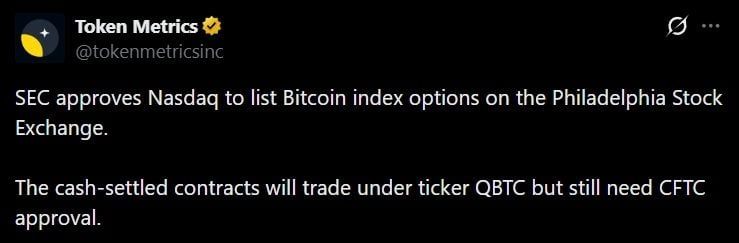
The Securities and Exchange Commission (SEC) approved Nasdaq’s application to list European-style, cash-settled bitcoin index options on the Philadelphia Stock Exchange (Phlx), adding another regulated instrument to the growing ecosystem of U.S. bitcoin derivatives.
The contracts will trade under the ticker QBTC and are tied to the Nasdaq Bitcoin Index, a benchmark that tracks one one-hundredth of the CME CF bitcoin real-time index, updating every 200 milliseconds using aggregated price data from major cryptocurrency exchanges.
What sets QBTC apart from other bitcoin-linked instruments is its structure, given that European-style, cash-settled options, holders receive the difference between the spot price and the strike price at expiration. No physical bitcoin is transferred, and there is no risk of early assignment.
That combination makes the product particularly attractive to institutional trading desks that want bitcoin price exposure without taking on the custody and operational responsibilities associated with holding spot assets.
Position limits are set at 24,000 contracts per side, roughly 0.12% of bitcoin’s total outstanding supply, with a minimum price increment of $0.01.
Despite SEC approval, trading cannot begin immediately because, under U.S. law, bitcoin is classified as a commodity under Commodity Futures Trading Commission (CFTC) jurisdiction, and the CFTC must grant exemptive relief before the Phlx can list and trade QBTC contracts. No timeline has been provided for that step.
An Accelerated Approval Under Chairman Atkins
The approval was granted on an accelerated basis under SEC Chairman Paul Atkins, whose tenure has marked a significant shift in how the commission approaches digital assets. Since early 2025, the agency has dropped numerous enforcement actions against crypto firms and moved toward clearer, more permissive regulatory frameworks, a posture that stands in sharp contrast to the aggressive approach taken under former Chairman Gary Gensler.
Moreover, the green light coincides with a period of significant turbulence for bitcoin-related investment products, with spot bitcoin exchange-traded funds (ETFs) in the U.S. facing sustained outflow pressure recently.
As Bitcoin.com News reported earlier this week, Blackrock’s Ishares Bitcoin Trust has been leading the pack as the outflow streak reached its fourth day, a run that has since stretched to six consecutive days with over $1.26 billion exiting spot bitcoin ETFs. Bitcoin itself is trading around $74,600 at press time, down from its recent local highs of around $82,000.
QBTC adds to an already maturing U.S. bitcoin derivatives landscape that includes Cboe’s bitcoin index options and CME Group’s futures-based options. The critical remaining variable now is how quickly the CFTC acts. The commission is currently operating with only one of its five commissioner seats filled, a staffing bottleneck that could potentially delay approval of the exemptive relief needed to bring QBTC to market.