
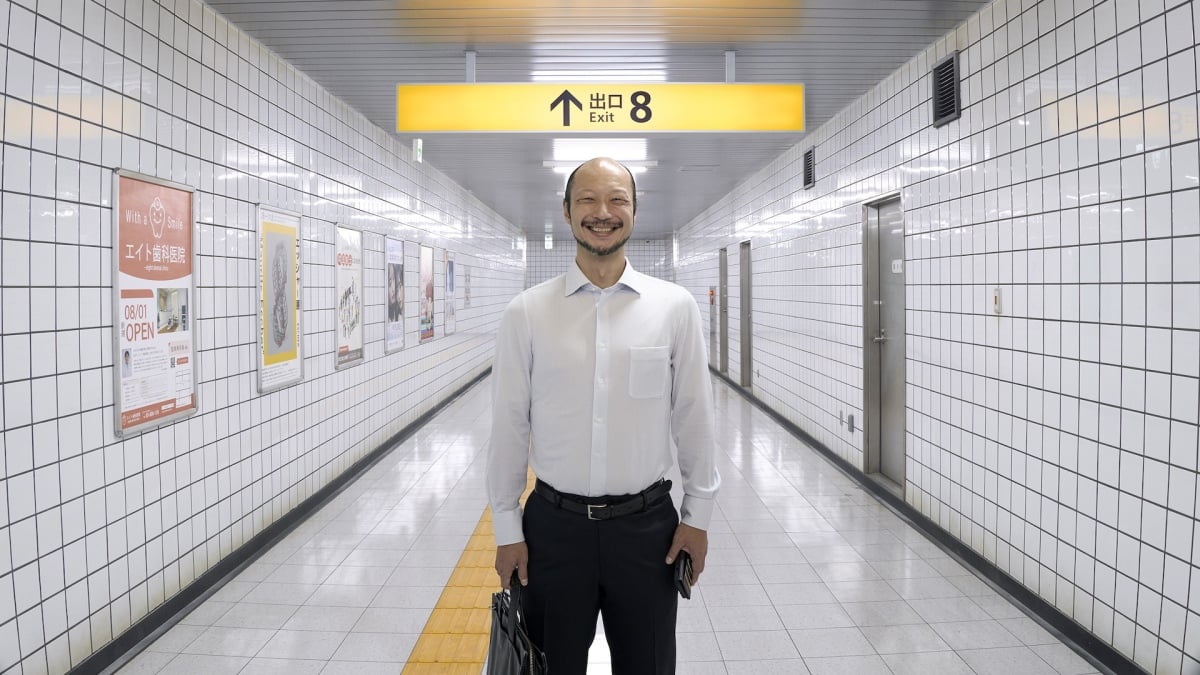
If you’ve ever felt like a lab rat in a hellish maze when trying to exit a subway station, you need to watch Exit 8.
Based on (and almost identically replicating) Kotake Create’s acclaimed 2023 game, director Genki Kawamura’s adaptation is a staggeringly meticulous piece of cinema. Fans of the game will be shocked to see those signature hallways come to life; newcomers will get to experience the maddening escape room for the first time.
At once a masterpiece of game-to-film adaptation, an elegant, nail-biting horror-thriller, and a technical cinematic marvel, Exit 8 locks you in and leaves you to flail. You’ll never see your commute the same way.
What is Exit 8 about?

Kazunari Ninomiya and Naru Asanuma in “Exit 8.”
Credit: Neon
To call Kotake Create’s game The Exit 8 a walking simulator is an understatement. This masterpiece of environmental storytelling is essentially a nightmarish spot-the-difference experience that ties players in knots when it’s not leaving them terrified. Like a Möbius strip, Exit 8 sends you into a seemingly endless loop, walking the same mundane yet unsettling subway hallway beneath Tokyo again and again, with the only chance of escape a mysterious set of instructions: If you find anomalies, turn around immediately. If you don’t find anomalies, do not turn back.
Kawamura and co-writer Kentaro Hirase expand this puzzle into three acts, installing a compelling protagonist, exploring other characters (including an outstanding performance by Yamato Kōchi as The Walking Man), and adding a running theme of fatherhood. We meet an unnamed man (an exceptional Kazunari Ninomiya) on his way to his temp job in the Tokyo subway. He’s crammed into a train carriage with thousands of other silent commuters, all glued to their phones in a deeply familiar image. When an upsetting confrontation occurs, he simply turns up the volume and zones out, the bystander effect in full force. He takes a rattling call from his ex (Nana Komatsu). When he tries to leave the station, he finds himself trapped in a mysterious looping hallway, tasked with facing (and identifying) chilling oddities — a door ajar, the sound of suddenly nearby footsteps, a disturbingly exaggerated smile.
While a seemingly simple concept, the themes running through this labyrinth are complex, from the drudgery of the nine-to-five to the weight of major life decisions to the concept of limbo. What is this place? An Escher experiment? A modern version of Dante’s Nine Circles of Hell? Kawamura will leave you frantically searching for meaning as you search for aberrations on the screen.
Mashable Top Stories
Exit 8 is a masterpiece of filmmaking, from production design to cinematography

It’s perfect.
Credit: Neon
The first time our “Lost Man” rounds the corner into Exit 8‘s all-important hallway, my jaw hit the floor. Production designer Ryo Sugimoto, set designer Yutaka Motegi, lighting designer Tatsuya Hirayama, and set decorator Yutaka Motegi have perfectly recreated Kotake Create’s generic subway setting to down to the very last detail, from the graphic design to the stark lighting and those cruel white tiles. It’s a magnificent feat, building this seemingly endless hallway for uninterrupted shots, captured with meticulous precision by cinematographer Keisuke Imamura.
Long one-shots track Ninomiya’s superb, overtly physical performance as he frantically attempts to escape the hallway and survive the disturbing jumpscares, many from visual effects supervisor Seiji Masamoto. The game itself wields first person perspective with every step, turn, or movement through space functioning as player-propelled cinematography, and Imamura expertly channels this into Exit 8, executing a hypnotic, unsettling march through these dreaded hallways.
However, none of this would hit quite so hard without Exit 8‘s supervising sound editor and foley artist Masaya Kitada. Sound becomes a bona fide weapon in Kitada’s hands, building dread from the crisp clack of footsteps and the buzzing of fluorescence, or straight-up terrifying you from inside a locker. Make sure you see this film with a monster sound system.
Exit 8 will have you playing spot-the-difference too
The key game mechanic of The Exit 8, spotting the anomalies, also functions as the narrative driver of the film, as the protagonist studies the few consistent elements of the hallway in order to spot anything amiss. Some anomalies are obvious, while others are microscopic. With the latter, deciding whether an anomaly is in fact one becomes as risky a move as deciding it’s not. It’s maddening, this constant state of flux between ennui, frustration, drudgery, and pure terror.
Through Imamura’s calculated cinematography, the audience is also able to play along in some instances in which we desperately roam the screen to identify an anomaly before the Lost Man does — there were more than a few moments when I pointed, pantomime-style, at the screen wanting to yell “IT’S BEHIND YOU!” Granted, fans of the game will be less freaked out by the startling nature of the anomalies, as experiencing them on a first-time play is as unsettling as watching the film.
While video game adaptations come in a range of sublime to mediocre, Exit 8 is a triumphant realisation and expansion of the original concept. Kawamura’s punctilious direction and his incredibly talented cast and crew amplify this contained hallway in satisfying, chilling ways. You’ll remain in this hallway long after you’ve left the cinema — we’re all still staring blankly at that Exit 0 sign.